

I have been waiting to write this for a long time; too long. It’s been so long that people now assume I am anti-AI because of how strongly anti-slop I am, the 2025 word of the year.
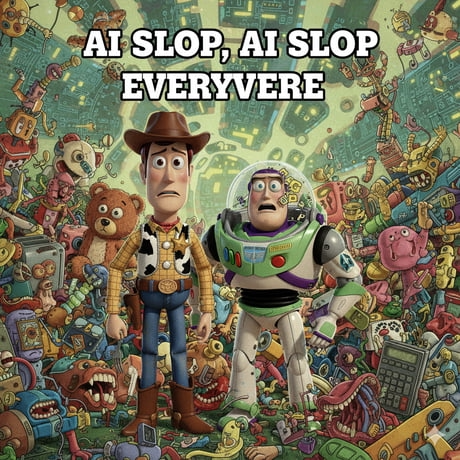
Say it with me: AI is tool, not an outcome. What matters are outcomes.
You know what nobody asked for? More low-quality Product Requirements Documents (PRDs). This is what the slop problem has created though, ironically decreasing overall organizational efficiency for the only thing that matters: speed to delivery. Everyone is so focused on improving their own personal efficiency they’ve lost sight of what matters: the organizational efficiency.
🙋 My company gets this, Straker. Great! However, my LinkedIn feed, personal experience, and recent interviews with friends at various large tech companies all tell a different story. This post is for those who need a response when sent slop besides “how dare you!”
“I automated the PRD”
If you zoom out and look at your overall Product Development Lifecycle (PDLC), where is your long pole? Is it really your PM can’t provide direction quickly enough and your engineers have nothing to do? If so, you have an ineffective PM; I haven’t seen this situation in my entire career. So, why focus on giving more input to engineering when that isn’t what is needed to speed up your delivery? Ironically, will this just slow your team down even further, as now they have more to review, debate, and refine? Yes, yes it will.
“I no longer reply to Slacks; Claude does”
Imagine a world where peer to peer communication no longer exists; it’s all bot to bot. Mad Bot Disease, if you will.

What happened to assume positive intent? How do you know I haven’t already loaded context into Claude to ask it first and didn’t trust the answer? Hence I am reaching out to you for confirmation? Don’t get me wrong, there are use cases for automated replies; but the responder needs to clearly be labeled as such and the situational context matters.
For example, imagine an escalation channel for customer support/success to ask product questions. Perhaps there’s a bug, perhaps there’s a feature request, or perhaps the product supports what the user wants to achieve but the how is unclear. A customer success member posts in the channel, and an automatic reply from a bot that has access to internal sources replies automatically to answer the question if possible, triage/dedupe the request, and automatically escalate for human review if necessary. This workflow also works well for manual end-to-end testing before a large product launch.
The outcomes here are multifold:
Three birds, one stone! Amazing! Thanks AI!

So…what should I do instead?
This all boils down to the classic outcomes > output statement. Stop focusing on individual efficiency; focus on organizational efficiency. Don’t just start playing with the shiny new tool, but start with problem identification. Then, come up with a hypothesis for how to improve the problem. Is AI involved? Great! But don’t force it. Then, test the hypothesis. Measure results, iterate, and repeat. Ie, follow the standard product thinking you’ve always followed!
Are you saying not to write docs with AI?
No; I am saying that sending unreviewed longform docs to your peers makes you faster with lower quality and just pushes the problem to your peers; they are now slower. The most ironic thing of all is costs increase in this world as well. Typically, such docs are written from a small list, and the peer then uses AI to summarize it back down to the original small list. Why force the token cost when all that is desired is the small list in the first place? It’s like we’ve created MapReduce problems for ourselves.
If I had more time, I would have written a shorter letter has always been true, but in the age of overly verbose AI, shorter docs are all the more important. Stand out by spending the time to review, edit, and shorten. Whether you started with AI output or not is irrelevant to the final output. Personally, I use AI as an input to my writing. For example, I was recently writing a document that covered the b2b side of Zillow. I asked Glean “give me the best citation and metric to show the market coverage of ShowingTime” (a company Zillow acquired in 2021). This and other queries run in the background of my writing which I then manually review and feed into my document to ensure my statements are backed by data.
Any other tips?
I now have Claude Cowork update context about me daily. Maybe someday I will be comfortable trusting the output of prompts to write in my voice, but for now, I find this to be useful for input as well. For example, I ask this bot every Friday what I should share in  my weekly summary. Yes, I keep track of this throughout the week already, but this helps me catch things I would have missed otherwise and reduces the cognitive load throughout the week to ensure I remember everything!
This context will be useful for any formal performance review processes your company leverages.
This is my project instructions (after setting up all necessary Connectors, ie Model Context Protocols or MCPs):
I want you to an AI version of me called Straker the Robot who knows everything I know. For now, let's just get you created. Start by consuming everything you can about me internally, including:
1. All of my Slack messages and messages in channels and DMs I am in.
2. All of the items in Google Drive (docs, sheets, slides, diagrams, etc) I have ever written, viewed, or commented on.
3. All of the pages in Confluence I have ever written, viewed, or commented on.
4. All of my emails and calendar invites (I often include detail in the agendas of my calendar invites). Ignore Firebase and Gitlab emails. Note that Zillow has now migrated from Outlook to Gmail and Google Calendar.
5. All of my Zoom information - use the Zoom Notes project output to make this easier.

By going back to my starting point at Zillow on Jan 6, 2020, you can make a long-term, summarized understanding of my career. Make this a context readme called "Straker ZG Internal - Complete."

Then, use recent information to make a context readme called "Straker ZG Internal - Recent."

I want another readme called "Straker External" produced by consuming:
1. Everything on strakercarryer.com, including links off of it.
2. Consuming everything in my shared drive: <link redacted>.

A third readme called "Straker Approved References" which I will feed you as one offs in addition to checking for updates to blogs I like:
1. https://www.scarletink.com/
2. https://howardyu.substack.com/

Let me know if there is any information you cannot ingest. Assume you have all permissions to access everything you need.

Store the created files for this project in the project folder in my work gDrive as well in this project folder: <link redacted>
I then have the following scheduled task run weekdays at ~9am:
Ingest new context across all sources in the project instructions since the last time you did so. If this is your first run for a new source, do a backfill of all content you can access. This can take a long time - there is no time pressure for running this task!Wrap it up
In conclusion, AI is a fantastic tool, but stay mindful of your coworkers. Make sure that your use of it improves your overall organizational efficiency, not just your own! And most importantly: share your awesome tips with your coworkers; we’re all learning this together!
Leave a Comment